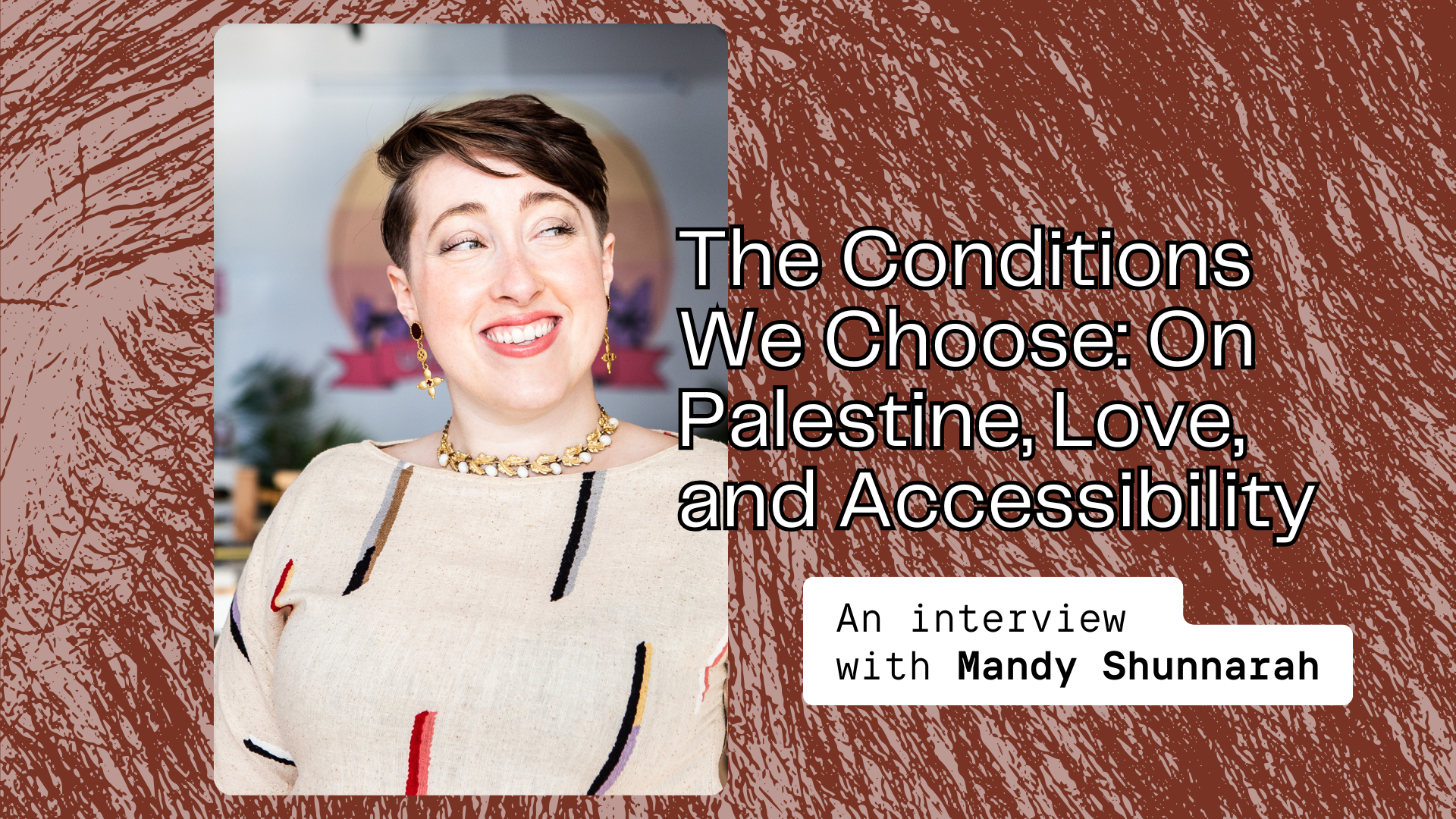
Mandy Shunnarah’s We Had Mansions showcases a writer committed to tracing the world’s various wounds and wonders. Shunnarah’s poems explore the effects of loss and exile, deconstruct Western hypocrisy, and speak to the peculiar grief of witnessing the genocide of your own people while living in the heartland of empire. Yet they also carve out space for love and desire with a sensualist’s attention to nature. Equal parts devastating and enlivening, Shunnarah’s poems have a propulsive yet open quality that invites the reader into a collaboration of sensory experience.
Over Zoom, our conversation roamed from process and history to the necessity of art and community with other writers, both living and dead. Shunnarah’s generous insights were both fortifying and motivating. I have found myself thinking back to their words often while wondering what it means to stay committed to the world in this present moment.
-Zavi Kang Engles, Managing Editor
(Note: this interview has been edited and condensed for clarity)
-----------
Zavi Kang Engles: I wanted to start by asking about how the book came into being. Palestine is clearly the center of gravity as a place and a politics and also as a direction of longing. Yet you also cover such a broad range of themes, including love, queerness, nature, and desire, all of it so beautifully layered together. Could you speak to how the book came together, including the decisions you made around structure and sequencing?
Mandy Shunnarah: So, the earliest poem in the book, I think I wrote in 2020, is “If Jesus Was Fat.” Before that, I had mostly been a creative nonfiction writer and a journalist. I always wanted to write poetry because I love reading it, but felt like I had a block there. And then I eventually just decided that I really wanted to get better at this genre, so I started taking workshops and going to classes. I wrote a lot of really awful poems until “If Jesus Was Fat,” and then that was the first one I was really happy with. And it didn't take long from there for me to start writing about Palestine and my family, because I was already doing that in my creative nonfiction, so it was already on my mind.
I was talking to my friend Ruth Awad, who is a Lebanese poet who lives in Columbus, and I was telling her, like, oh, I'm writing all these poems, and a lot of them are about Palestine, because that's how I'm processing my grief and thoughts. But I couldn’t see the connections between, for example, the love poems and the Palestine poems. I felt like I had all these disparate buckets. She was like, “well, how many poems do you have?” And I said, “oh, 70-something.” And she said, “I guarantee you, if you have that many poems, there is a throughline. You need to print them all out and arrange them on your floor.”
So I took that advice and I did start seeing throughlines. As for the order, I decided that I would first ground the reader in where I'm coming from. And I wanted to be very clear about the fact that my family is from the West Bank. I have not personally experienced genocide and I always want to prioritize voices from Gaza first and foremost.
So I opened with talking about my family, and then bringing that to the present day, the genocide, because Palestinians in diaspora and in the West Bank are not unaffected by what's happening in Gaza. You know, we're witnessing it. I'm also a journalist, so watching journalists in Gaza be murdered by Israel, and seeing how Western media has covered that very poorly and very unethically has been difficult to watch. So family, genocide, and then I start getting into the love and nature poems. And I see love and hope as being integral parts of Palestinian identity.
ZKE: Can you say more about that?
MS: Well, this is not the first time that Gaza has been colonized. Before Israel, it was the British, before them, it was the Ottoman Empire, and you go back, back, back. And part of the reason is, it's Southwest Asia leading into North Africa, there's sea access, there's a lot of historic trade routes that have gone through Palestine. And somebody has always wanted what we have, whether that's land, resources, or port access.
When your people have been colonized for so long, what keeps you going? I think the answers are love and hope, which I know sounds trite or simplistic. But at the end of the day, if my people didn't love their land and their family, and hope for a better future, and hope for a free Palestine with every fiber of our being, why would we go on? So I wanted to show a more complex portrait of Palestinian life, even that of a diasporic Palestinian, because Zionists constantly say Palestinians don't exist, or queer Palestinians don't exist. Or, you know, insert whatever Palestinian here doesn't exist.
Yet the fact is that we've always been here. We've existed for a very long time, but people, especially in the U.S. and the Western world more broadly, tend to have very simplistic views of who we are, and they also tend to relate to us through the trauma of being colonized.
So I wanted to write about love, hope, and joy and the conditions that we choose for ourselves, not just ones that are imposed on us.
ZKE: In your introduction, you write that “every love poem is a Palestine poem and every Palestine poem is a love poem.” And I was thinking about this, in relation to the James Baldwin quote, “the role of the artist is exactly the same as the role of the lover. If I love you, I have to make you conscious of the things you don't see.”
There's this painful irony right now that, in a sense, so much can be seen. This is the first livestreamed genocide and yet these atrocities continue to be either unseen or misinterpreted because they're mediated through the controlling technology of language.
There remains this problem of language and what we do with it, and how we interpret what is being seen. In light of all of that, I was wondering if you could talk a little bit more broadly about the role of the artist in making others conscious of the things that they don't want to see.
MS: I have a friend, the poet Dr. Travis Chi Wing Lau, and he wrote What's Left is Tender, that just came out from Small Harbor Press. He says, “Poetry without praxis means nothing.” And when I go into a poem, especially if I know I'm writing about my people, I have three goals. To educate, to entertain, and to inspire positive action. Not every poem is going to do all three things, but that's always what I'm hoping for. And not to say that poems can't just be fun for fun's sake, or beautiful for beauty's sake. But when I think about what I want to do with my work, and what drives me to write poems, it's really education, entertainment, and inspiring positive action.
Poetry is so powerful because of its economy of language. I've never been asked to read an essay at a protest, but I've been asked to read poems. And I think there’s just something about the volta. I love to end on a couplet that punches you in the gut, you probably noticed. That really stays with you, if not the exact words, then the feeling that you get from hearing them.
ZKE: Yes, absolutely. I was really struck by the clarity and precision of your poems throughout. Could you talk about how accessibility as an ethic guides your writing practice and your poetry?
MS: I’ve been a journalist since 2009. We're taught that the goal of journalism is to educate and inform, right? The average person, at least in the U.S, has a 6th-grade reading level, so how can you write in such a way that you're distilling government policies or community issues in a way that basically anyone can understand. Being a journalist developed my ethos as a communicator.
I also learned more about this tradition of docupoetics in Palestinian poetry and Arab poetry in general. And docupoetics is just the portmanteau of documentary and poetry, where you bring journalistic practices into the act of writing the poems. So that could be archival research, interviews, looking at works of journalism and translating them through an artistic lens. I think one of the reasons why Palestinian and Arab poets in diaspora gravitate towards docupoetics is because people love to say, Oh, it's so complicated. And they use that as an excuse to not learn more. And it also gets weaponized by Zionist propaganda, where they're like, Well, who are you to speak on Palestine? Are you a scholar of the Middle East? Do you have a degree in political theory? And then people are afraid to learn more because they worry they're not smart enough, or they're afraid to speak up because they're afraid they'll get it wrong.
But so many people have told me that my poems help them understand Palestine and what we're up against, and also see the diversity of the Palestinian experience. Docupoetics allowed me to do that and accessibility is part of the style for me. I don't plan on doing it any other way.
ZKE: Could you talk about your decision to break up the different sections of your book with quotes from other Palestinian writers? As I was reading, also going from the title, I had the sense that each quote was leading us into a different room.
MS: I love writing in my books and I have a whole Palestine and Arab Lit shelf in my office. And, so I mark up books, I'm constantly highlighting, and if there's a quote that really resonates with me, I'm putting it in a notebook, or in my notes app, and so I just am constantly surrounded by this wisdom, and whenever I feel alone or like life has gone off the rails (which I think a lot of us have felt that especially over the past two years) I dig into this quote archive. The quotes range from poets who are alive and working today, to poets who have been murdered by Israel, to poets who were exiled and never got to go back to their homes and who died decades ago. So, I wanted to bring in voices from the past and present who have been writing about Palestine, and just showing that the work is ongoing, and that I'm not alone in this; they're not alone in this.
Because a lot of us diasporic Palestinians have felt so alone and isolated. There's something unique about the experience of watching your own people's livestreamed genocide, and then having Zionists look you in the eye and tell you that this immense suffering that you're seeing is not real, or it's not actually happening, or it's fake in some way. And seeing how misinformation, combined with AI and all these other insidious technologies work together to further the Israeli PR machine and murder Palestinians. For people who haven't had to watch that happen to their own community and people, you just don't get it. And no one should have to get it, to be clear. I don't want anyone to feel this. I don't want anyone to experience this. And so I've really leaned into books just as a way of reminding myself that I'm not the first person to do this work. I will not be the last and I'm certainly not the only one.
So the book’s quotes show both where my inspiration comes from and give credit where credit is due. Mahmoud Darwish showed me what love poetry can do, and especially, love poetry from a Palestinian person. One of the last people I quoted is Mona Gazala*, and she is a Palestinian poet, textile artist and filmmaker. She's one of a handful of Palestinians in rural West Ohio, in one of the most sparsely populated counties in Ohio. And she's got an art gallery and a decolonial library there, which she welcomes the community into.
So the quote that I used from her is actually from her film Closeness to the Land, where she talks about wanting to buy a plot of land even though she doesn't have a lot of money, wanting to buy her own building even though it's old and rickety, and a challenge to maintain it in this rural community, because it was all she could afford. But she wanted something that was hers, truly hers. And how that's a deeply ingrained need for us as people who have been exiled. But she’s also grappling with the fact that it's not really hers, because it was Native Americans’ before that. When you exile one group, you become an unwitting participant in the exile of another group. All of these people have inspired me in some big ways, so I wanted to bring their voices in.
ZKE: I love that. And I also wanted to say how much I loved the nature section that the Gazala quote introduces. In particular, the lines “I collect/what the land willingly gives. My partner says,/I think you were a naturalist in a former life./Perhaps. Or maybe I’m just Palestinian in this one.” Such a concise articulation of connection with and longing for nature that also gets to the heart of how colonialism disrupts that connection.
I wanted to ask more broadly about your writing practice. In addition to communing with other writers, how else do you nourish your practice?
MS: Ancestor worship is a big part of my writing practice. To give a quick back story, I grew up in four different Christian sects, Orthodox Christian on my Palestinian side and Southern Baptist/Catholic on my Appalachian side and then I also went to a fundamentalist Baptist Christian school growing up in Alabama. When I was a teenager, I became an atheist to rebel and then as an adult stopped going to church. A couple months before October 2023, I had this hard realization that I didn’t want to be married to the man I was with at the time and would need to initiate separation. Then October 7th happened and I was at one of the lowest points in my life and I just had this overwhelming urge to talk to my ancestors, specifically my grandmothers.
It was the closest thing to prayer since I stopped believing in God. I just talked to my grandmothers, all of whom I knew in life for varying lengths of time. So, I just walked around my house, telling them about what was going on in my life, and in Palestine, and all the things that were stressing me out. And I couldn't even tell you how long we talked. But when I was done, I felt this peace come over me. And as trite as it is to say, I just felt like everything was going to be okay.
That conversation with them gave me the strength to tell my husband it was over. And I've continued my ancestor worship practice. I credit everything in the book to my ancestors because, I'm going to be real with you, I'm not that smart. I don't think I would be coming up with this stuff on my own. I really credit the wisdom of my ancestors with every insight that's in We Had Mansions. And the book is kind of my love letter to my family.
ZKE: The seismic shifts that you went through in such a short amount of time, that must have been so heavy, and that's so beautiful that you found a way to sustain yourself and grow new connections with people who are no longer here yet are still with you. Thank you so much for this conversation. Before we close, is there anything else you’d like to share with the Apogee community?
MS: I'd love to just end with the suggestion that you read Gazan writers, new and old, and also donate to the Sameer Project. They are a Palestinian mutual aid organization that has been able to feed people because they work with people on the ground. So just big love for them and please donate to them.
Mandy Shunnarah (they/them) is an Alabama-born, Appalachian and Palestinian-American writer who now calls Columbus, Ohio, home. Their essays, poetry, and short stories have been published in The New York Times,Electric Literature, The Rumpus, and others. Their first book, Midwest Shreds: Skating Through America’s Heartland, was published in July 2024 by Belt Publishing. Their second book, a poetry collection titled We Had Mansions, was published by Diode Editions in July 2025. Read more at mandyshunnarah.com.
Zavi Kang Engles writes, walks, and tends to two cats in Tovaangar / Los Angeles. She is the Managing Editor of Apogee Journal. As a PhD student in the Department of American Studies and Ethnicity at the University of Southern California, she researches affect and embodiment in Asian American literature and Korean American shamanism. For more, go to zavizavizavi.com.
------
* The quote is as follows:
I needed to have a sense of belonging to the land.
Even if this piece of earth is really a proxy, a stand-in
for another piece of earth far away,
I still wanted that closeness to it.
My ancestral homeland is Palestine,
and I have never been there.
I may never get the chance to be there.
What does it feel like to have that bond with the land?
To know that place intimately as your own throughout time?
— Mona Gazala