


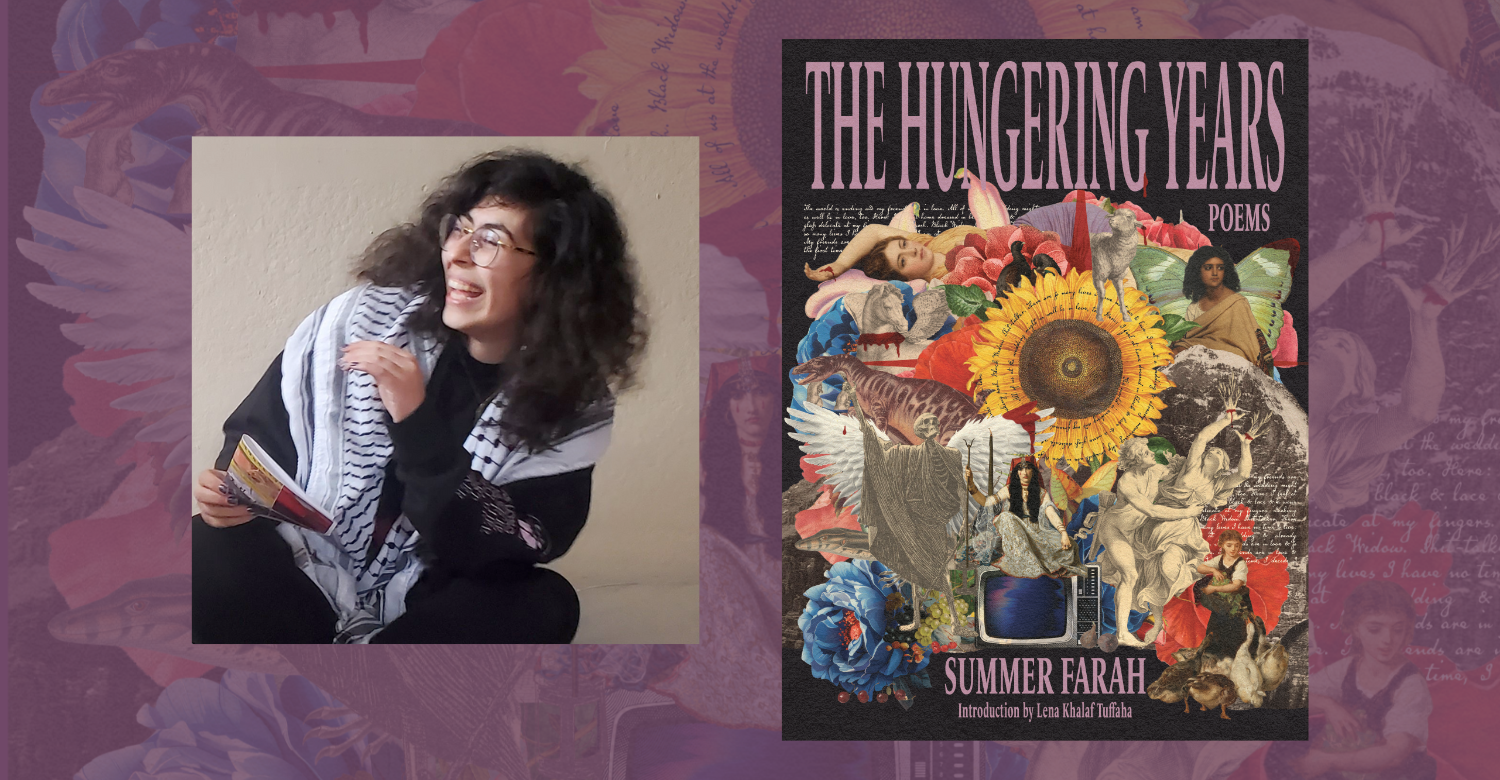
One of the things I often repeat when talking about the difference between poetry and prose— in workshops, at readings, in casual party conversation— is that a poem compresses time. In Summer Farah’s debut poetry collection, The Hungering Years, poems count stolen objects in the rare treasures room of a colonial museum. Poems sing of love, and Palestine, to the Dead Sea. The writer’s past grazing the reader’s present, the overdetermined present biting the heels of the unwritten future, all in the span of a few lines. “No,” a friend corrected me recently, “a poem exists beyond time.”
I am reminded of a line from Aracelis Girmay’s the black maria. “What verbs will I use to describe the living of my beloveds?” What actions, as in, what ethics? In relation to time, Summer Farah’s debut poetry collection The Hungering Years gathers, extends, unspools, spirals, echoes, reaches.
From the moment we enter Farah’s world, we are invited to pay attention. She lays out the objects of her investigation with the care of someone playing show-and-tell with a beloved friend, not to impress or win over, but to share in a mutual, parallel delight. Even the table of contents is not merely descriptive. Rather, it is lyrical and instructive, attuning the reader to Farah’s ear for repetition, and building an index of cultural references to come. I am not “chronically online”, not fluent in the flux and flow of internet idioms, but Farah’s Tumblr girl anti-colonial academia moodboard still hits: the “noooo don’t ____ you’re so sexy ahha” and “what’s it called when __” memes, the allusions to astrology and 2010s fandoms. To read the table of contents is to assemble a poem made of titles: the angels are falling / the figs are molding / the children are screaming / the birds are calling.
The poem “A YEAR AFTER I FIRST LOVED HAIKYUU!!” maybe says it most plainly: “What art has invited you to treat yourself better? What art invited you to consider care as inherent to craft? And how did you fulfill its invitation?” To try to understand one of Farah’s answers to these questions, I write this review listening to Mitski. It takes me a minute to decide which album feels most fitting, as a soundtrack. Be the Cowboy, with its orchestral loneliness? Puberty 2, with its disenfranchised yearning? Or The Land Is Inhospitable and So Are We, titrating between misty romanticism and primal alienation? In the end, following Farah’s cue, I allow myself to lean into devotion and simply choose the album I love best (I’ll leave you to guess which one that is.)
Farah’s work is rhizomatic with references, both intra- and intertextual. “READING MARY OLIVER IN LA VERNE,” which opens the collection, evokes the poem “Reading Darwish in Vermont” from Zaina Alsous’ debut, A Theory of Birds. “Oh, how badly my language shows American—densely haunted / and subtitled,” writes Alsous, and Farah responds, “I wonder which zip code suits me best. / My fromness is false.” The body of imperialism, laid on top of the world (to use an expression coined by Palestinian writer and revolutionary Ghassan Kanafani), forecloses the possibility of a simple or unburdened origin story. And yet, fromness necessitates a somewhere-else that follows, fig tree saplings forcing their way up through cracks in the colonizer’s narrative. Farah’s poem goes on: “A life, sort of. There was something to start, sort of.” In this line, an echo of Solmaz Sharif’s “Beauty” — “Tomorrow—I say / A life is a thing you have to start” — a poem Farah references again later in the collection.
Over the course of The Hungering Years, return becomes a practice, as Farah repeatedly refracts her cultural influences and obsessions through the lens of conversation with literary ancestor Etel Adnan. It is interesting, then, that the book’s first poem turns not to Adnan, but to Mary Oliver. In other interviews about her work, Farah has spoken of turning to Oliver in times of personal crisis, refuting any slander of Oliver’s poems as less-than-literary. This is a concern that repeats itself throughout the collection, which Farah treats by example rather than argument. Art’s worth is evaluated not in its institutional legitimacy or its commercial value, but in how it acts on us — a property that is idiosyncratic and irreducible. Video games share a stage with lesbian period dramas, poems inspired by 2021’s Unity Intifada with shonen manga and fan fiction. “Every person I have told to read Mary Oliver,” Farah once said, “they've been like, wow, I don't want to kill myself anymore. You know, not to be crass.” How Oliver addresses the reader as if they could be anyone. How she holds every detail with a sacred regard. “Watermelon, overripe figs, anything to attract / a wasp, anything to incite panic, anything to start my heart,” Farah writes. Spoiler alert: her own poetry has the same effect.
Farah engages the speculative and surreal as a mode of survival. Fandom becomes an act of agency; not so much accidentally blurring the line between reality and fantasy as actively wiping it away, in search of a more livable world. The epigraph to “I TELL ETEL ADNAN ABOUT ERAGON” highlights this vertiginous moment between encounter and devotion: “It’s as if someone suddenly opened a door for you. You take a first step, and you decide whether or not to stay.” In her review of Alsous’ A Theory of Birds, Farah writes, “I often engage with the speculative as a language for engaging with liberatory political frameworks—let our minds wander toward the what-if and undo the bounds of the colonial structures we have learned and existed under for so long.” Perhaps resistance, struggle, the act of grappling with our own imaginations, is what allows us to carry on with any sort of clarity or grounding.
“You change me: the way I consider the fog, my attention to death, a desire for the surreal right where I stand,” Farah confesses, in “I TELL ETEL ADNAN ABOUT MITSKI” — the second poem in the book, and the first of her exchanges with Adnan. Importantly, though, the surreal is not an abdication of responsibility for the real. Farah’s robust poem notes describe an interaction between Mitski and a fan during a March 2024 show in Chicago, five months after Al-Aqsa Flood and its breaking-open of Israel’s colonial timeline. In response to a fan questioning her stance, which up until that point she had kept completely opaque (one can only assume intentionally), Mitski said “Was there any doubt? Free Palestine!” — her deflection symptomatic of the cultural sector’s nonchalant normalization of Zionism.
This is another question that afflicts me, reading The Hungering Years: How do we forgive ourselves for loving the art and the artists we love — politically convoluted, ethically imperfect as they might be? And when what we love aligns itself with a world that hurts us, where do we draw the line between self-harm and self-soothing? “I refuse to let sunlight in / just in case it reminds me that I am real,” Farah writes. “At night I worship the artificial glow / of all of the things I’ve been told might kill me.” A foolishness, in the tarotic sense; that is, spontaneous, stubborn, full of potential. I find this devotion to devotion irreparably moving. Life that insists upon itself as ordinary, as worthy of pleasure, despite the daily attempted degradations of the state.
At the same time, there is a shadow self that rears its head. “Even in games I am afraid; even in games I back down.” The self — ambivalent, persistent, historically contingent — is inscribed into every layer of experience, from skin to viscera. The body’s idiosyncratic ailments serve as an archive of displacement and occupation. “Pressure has / been building in my lower back for years; everything in the / gut conspires you must change your life,” Farah writes, in “THE ANGELS ARE FALLING.” In “I TELL ETEL ADNAN ABOUT MY PUSSY PROBLEMS,” she writes: “An itch, a heat—lines cover my stomach / like cat scratches, an abundance of soldiers trample a yearning hand.” “those who cannot leave / discover the geography / of the body,” Adnan writes in Time. Farah extends this observation to map what happens in the body when one has been forced to leave over and over, but now, in the historical present, is saddled by stasis.
Delicately, too, these poems balance suicidality between the poles of presence and absence, staying and leaving. What is more alive than desire, even if the object of that desire is death, even if one is not doing anything, does not want to do anything, to consummate that desire? The book draws its name from the poem “THE FIGS ARE MOLDING”, which sets into clarity this conversation between longing and inertia, excess and abundance, history and hunger. “I imagine a world in which I have no hungering year,” Farah writes, “a world that does not make me wish to have one.” By the time we arrive here from the opening poem, the overripe figs Farah invoked to start the heart have begun, instead, to rot. In time is the thing a body moves through, their book-length meditation on art, Félix González-Torres, physicality, and relationality, T Fleischmann contends that a poem is good at thinking about what is inside of a moment. In The Hungering Years, Farah uses a poem to think about what is inside of a lifetime.
Repetition is an essential engine of Farah’s poetics, so full of spirals and returns. Nasser Abourahme’s essay “In Tune With Their Time” argues that a colonial project is a chronological project; an attempt to conquer time. Israel — brutal and defeatable — is stuck at the moment of its “foundational conquest,” unable to “move past the past.” Abourahme understands this moment as an expression of the Zionist regime’s frustration at its inability to ultimately suppress and disappear Palestinian life, the corner it has backed itself into over the past 77 years, and counting.
In contrast to Israel’s frenzied and frightened attempts to exit this impasse through utter genocidal incitement, Farah’s poems turn on efforts that, as Lena Khalaf Tuffaha writes in her introduction to the collection, keep us “reaching toward life.” She transforms endings into returns and returns into beginnings; choral, cyclical, collective.
There is the movement between “POEM FOR AKKA BEFORE SETTLERS TORCH PALESTINIAN HOMES, MAY 2021” and “POEM FOR AKKA AFTER SETTLERS TORCH PALESTINIAN HOMES, MAY 2021,” where Farah uses erasure to reconfigure pieces of love for home and place and sea, what remains after an act of colonial violence fragments the scene. There is the ending that hangs on a comma, that refuses enclosure, “saying Palestine, saying Palestine, saying Palestine,” — there is the ending that reaches for song, “a desire for desire, a desire, a desire, a desire,” — there is the ending that draws time into a circle, “before & before & before & before & before & before.” Farah’s repetition propels us forward, the past relinquishing the future as her language pushes on. Another line from Adnan’s Time: “There are moments when / the past ceases to be a form / of the present.” The Hungering Years is full of these moments, where the historical and the surreal meet, her language imbued with the potential for rupture.
Seeking something for that language to push against, perhaps, Farah finds the prose poem: the perfect vehicle with which to explore constraint, the page pressing inward on all sides. Inside the prose poem, maximalism verges into excess, attention into obsession. Sentences arranged side by side place everything on the same plane of importance — fig trees, friendship, chronic illness, bed sheets, the supernatural, the show Supernatural. In “BLAME IT ON THE MOON, BABY,” the placement of a period punctuates the rhythm of a preoccupied mind: “I am always doing something wrong … If I leave my room I’ll die. If I touch the water I’ll die. If I tell a doctor I’ll die. I’d like to blame the moon. I track my symptoms with its cycle.” Repetition seems inevitable here, our path through the poem prescribed by the speaker’s ruminations. But at some point, the repetition ruptures. Hypothetical constructions give way, once again, to declaratives — “I love excuses”, “I look to the sky” — dragging us back from the anxious future into the present.
Abourahme writes that “The most primary organising logic in colonial order is separation. This separation is not simply physical or spatial. It is ontological and psycho-affective. It is a separation between subject and object, between the living body and the ‘body-things’ around it. Colonialism, then, takes the entangled intimacies, the dependencies on native bodies, labour, land, energies and presences, and transforms them into separations and a refusal of mutuality or any kind of commonness.” Farah’s prose poems oppose this logic, digging deep into the interiority of a body, a landscape, even a symbol as overburdened with meaning as the moon. These poems generate insight not by association, but by arrangement. They are framed by relation; that is, by surfaces in contact. They are interested in touch as reciprocal, rather than intrusive. “I will admit, I am using you, Etel,” says the speaker in “I TELL ETEL ADNAN ABOUT JULIA & JULIA.” When the poem risks overstepping the bounds of the intimacy it has earned with its object, it is aware of doing so, changing course at the last moment.
Farah trudges this circular track from devotion to obsession and back again, with no escape nor any particular impulse towards it. Again and always addressing Etel, this time as a peer in the practice of absence, Farah traces fixation as an inheritance. “We know the worst types of distraction, so let us love our obsessions, aches & all, for as long as the sky is clear.” In the book’s end notes, Farah writes of returning to the 15 seasons of Supernatural as much as Adnan, famously, returned to Mount Tamalpais. (“I understand, I tell her, the desire to not only return but to be consumed.”) If there is any theory of art Farah puts forth in this book, it is this equalizing of influences. Pop culture, immanently transient, moves alongside the mountain’s geologic time. Literary prestige alongside Tumblr virality. In an essay on Etel Adnan’s The Arab Apocalypse and Theresa Hak Kyung Cha’s Dictee, Farah describes art history as a comparative practice: “to put a collection of paintings next to each other and make conclusions about the time, to consider the world that presses into the frame.” Pressing, pressing, that encroaching action of anxiety, or the paradoxical presencing of an absence that cannot be filled. Ed Park offers an introduction to Exilée and Temps Morts: Selected Works, a 2022 collection of Theresa Hak Kyung Cha’s previously unavailable art and writing. For Cha, Park writes, exile is “dead time”, the void between two separate spaces and times, which can only be restored by an actual return to the place.
And yet, wherever loneliness — both geographical and relational — appears in The Hungering Years, so too does friendship. The void of from-lessness and anxiety’s desperate grasping at worthiness alike get transformed into “the gentlest of silences,” “the space between two couch cushions.” Farah’s is a subtle, serendipitous kind of friendship, one which does not disavow loneliness, one which exists in parallel proximity more than daily entanglement (“All of my friends live in a little box and isn’t that the most apocalyptic of them all; paradoxical. They are with me but never near me.”), one which demands the setting-down of a self-narrative as perpetual loner in order to be felt. I’ve learned about Farah as a writer as much through her practice of writing reviews as her practice of writing poetry. I understand this as an ethic of reciprocity; in both her reviews and poems, Farah pays homage to the literary ecosystems that raised her. “Can I draw you my most favorite map,” the speaker asks Etel earnestly, “a star in every corner to represent the people that I love? This knowing becomes exponential; without you I would not have them, without them I would not have you.” The sincerity is palpable, almost delirious, an outward-spinning desire to honour the art and the artists, many of them beloveds, who helped her not only grow, or take up space, but be alive.
“There are so many lives I have not let myself live, restless, paradoxical, tripping instead into the imaginations of others,” Farah writes in the closing poem,“AFTER WE WATCH ROADFOOD I CONSIDER PLACE.” But is it a paradox? That the poem’s speaker, beset by “teenaged devotion” and ancestral hunger, has spent so much time with and in art throughout this collection; that Anthony Bourdain has seen more of Palestine than she has; that she clings to the possibility of someone, or something, waiting for her in Nazareth; that some of those lives were, in fact, stolen from her; that she stomachs the risk of failure and insists on creating her own art anyway?
In a conversation with Fargo Tbakhi, frequent interlocutor, friend, and comrade, Farah cites Tbakhi’s much-shared essay “Notes on Craft: Writing in the Hour of Genocide,” asking again about the relationship between failure and pressure and effort. The collective failure to stop Israel’s genocide against Palestinians; the pressure exerted by “craft” as determined by the cultural marketplace; the effort, despite, to write through that failure, to try again and in a different way. “I TELL ETEL ADNAN ABOUT MITSKI,” which early on brings together the two most recurrent figures in this manuscript, frames desire as effort in the face of inevitable failure— “a desire for what you create to not consume you, a desire to create through the consumption, a desire to live past the consumption, a desire for death, a desire for desire.”
In contrast to traumatological narratives of diaspora and displacement, Farah does not always determine a historical origin for these desires. But neither does she treat art as a stable good in and of itself, divorced from the material conditions of its production and distribution. I recall Fleischmann, on González-Torres: “In intention and execution, his work is as driven by motors of dissent as by the mechanisms of beauty— or rather, the mechanisms of beauty as brilliant dissent.” Farah’s fig tree being analogous, perhaps, to González-Torres’ wrapped candy, or ; each instance of the fig tree both metonymic and singular. The fig tree which scales the side of a stone staircase, attracts wasps, breaks a fast, molds in palms, grows in the desert, allows indulgence, models an inherent worth beyond symbolism.
Toward what horizons, then, does Farah’s motor of dissent propel her work? Against colonial separation, against self-enforced isolation, against body and spirit moving in disparate directions. Against survival as a static act, creation as a finite one— “Sometimes the hungering year returns, as long as a second / a yearning / a spiral.” Farah allows every piece of art she encounters, every trace of desire she feels, to touch. Tbakhi writes: “RETURN IS AN ONTOLOGICAL DANCE STEP! THE BIRDS ARE TEACHING US TO STAY!” If the world is ending, these poems sing, let us go down dancing. Laughter is conspiratorial. To linger in friendship, to let go the self-righteousness of loneliness, is to be unafraid. Return is a process of becoming— “a desire, a desire, a desire,”
Jody Chan is a poet, multidisciplinary artist, care worker, and community organizer based in Toronto. They are the author of three books of poetry: sick (Black Lawrence Press, 2020), impact statement (Brick Books, 2024), and MADNESS BELONGS TO THE PEOPLE (Brick Books, 2026).

.png)


