


.png)
I first encountered Tala Khanmalek (aka mecca monarch) in May 2022 when they submitted materials for the literature-and-music podcast I cohost in Honolulu with Jocelyn Kapumealani Ng, It’s Lit with PhDJ. We had just published an episode featuring heidi andrea restrepo rhodes, whom I’d met at VONA years earlier, and heidi had done us the honor of sharing our call for materials with Tala.
This, and processes like this, is how community blooms. I know this even though I also don’t understand how Tala and I have still not yet officially met in person, as of this writing (though we were in the same room once in 2018!). Tala’s work draws you close, and the intimacy their work creates is a testament to their creations.
As part of their submission to It’s Lit and that first episode we ended up making together, Tala shared the first piece they’d written about their father after his death. I was struck by the complex feelings of love and critique Tala was able to hold at the same time for him and his “posthumously found objects.” Today, I’m thrilled to see this piece is now part of Tala’s chapbook An Infinity of Traces, forthcoming with Blue Cactus Press in late 2026. I am so looking forward to holding this chap in my hands.
The conversation that follows touches on ekphrasis, what it means to write into the space between us, how uncategorizable both love and liberatory writing are, the ceremonies that must be found amid this era of violence with ICE and the US-Israeli war machine, the link between parenthood and grief, a butterfly who is also a grandpa, and much more.
Anjoli Roy (AR): Tala, what a beautiful chapbook you have created. Thank you for letting me read it and for the gift of getting to talk story with you about it.
Tala Khanmalek (TK): Thank you for doing this. I have long admired you–as a writer, person, parent–and I’m honored to be in conversation. I hope it’s the first of many more exchanges.
AR: The feeling is deeply mutual!
I love your approach in this chapbook. You combine creative nonfiction and poetry alongside the visual art you produced with the two photographs of your father that you immersed in the Pacific Ocean and other natural spaces. Ekphrasis is a powerful bridge between text and image. Can you tell us about your process of producing this mixed-genre chapbook?
TK: In the wake of Baba’s death, writing with his belongings was the only way that I could language my grief. Objects anchored me to the letter even as grief eluded words. Among these objects was Baba’s Certificate of Naturalization, which includes his photograph.
I started to write ekphrastic poems about state-issued as well as personal photographs in an attempt to understand the material conditions that produced such radically different images of my father across spacetime. I wanted to touch my father again, but all I had was these objects conditioned–or else foreshadowed–by violence.
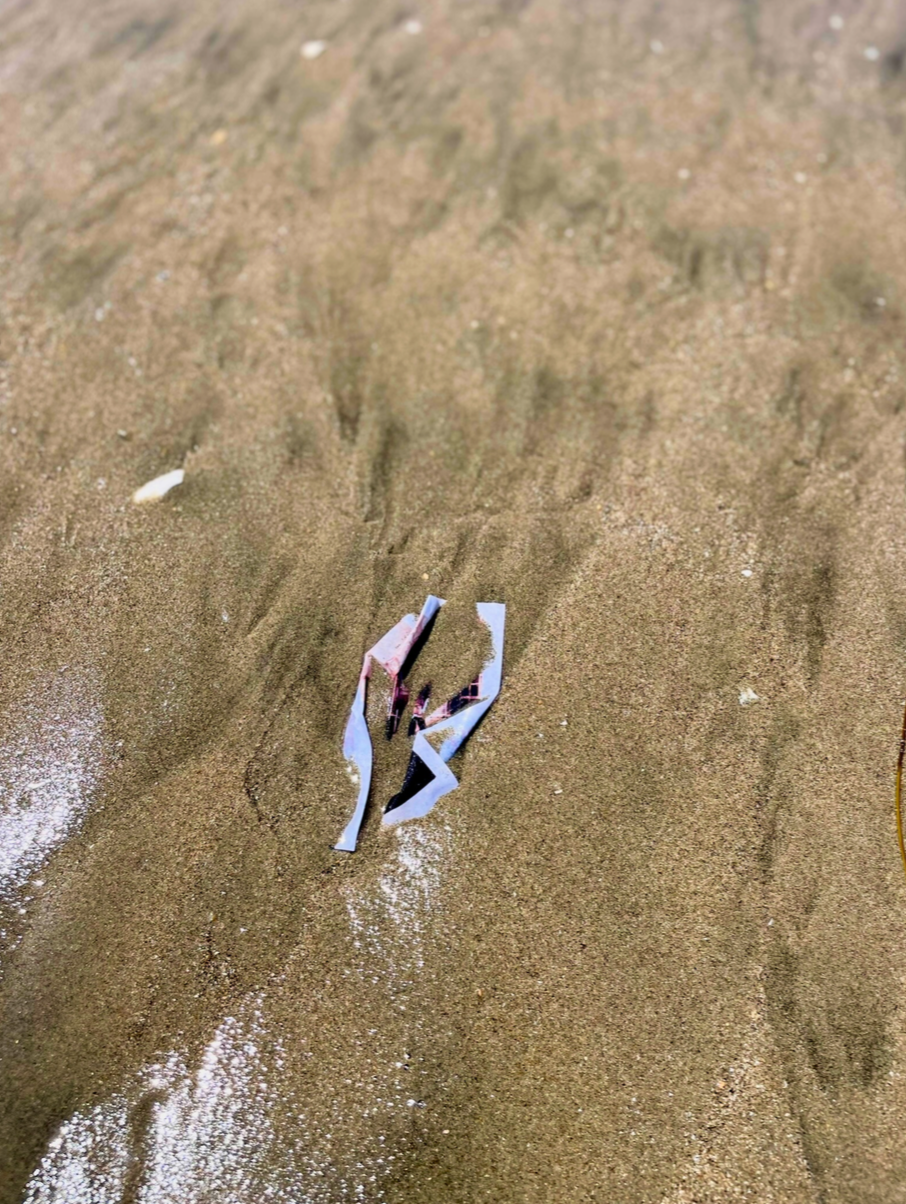
With encouragement from poet Diana Khoi Nguyen, who I met at Tin House 2025, I then started to alter the photographs myself. I simultaneously documented how elemental forces that we often think of as neutral and “natural” yet non-living, like water, altered the photographs too.
Now, I’m combining image with text to reach for an even more complicated story so far beyond the limits of English that I’m constantly rendered without a tongue, without speech, without form. For me, this ongoing process is my diasporic ritual of mourning within the imperial core as History slaughters on.
AR: The desire to touch your father again. Thank you for that tenderness. Thank you for the ways you are reaching beyond English in how you render, and render without a tongue. You write your father and hold his image in these natural spaces, and you demand the reader see him as the speaker does, as a subject flawed by empire. Can you talk about your approach in writing him? How, if at all, has the creation of this chapbook helped you better understand yourself?
TK: I never aimed to write my father. In fact, I don’t think it’s possible to write him, or anyone, really! I’m curious to hear your thoughts since you’ve been writing about your great-grandfather.
For me, the place of possibility is the formless place of our relationality, of all that exists between my father and I.
This chap has pushed me to face my own investments in legibility and, little by little, to betray them. That’s why there’s a ghazal alongside my collages. In my attempts to articulate the unspeakable, I moved further and further away from legible poetic structures until, for a period, I completely abandoned text.
I remember talking to Alexis Pauline Gumbs in the midst of this shift for “Personal Limits,” Monica Huerta’s series on personal writing, and landing on the need to abolish genre. I would add, following poets like Fargo Nissim Tbakhi, that we also need to abolish craft.
When we write towards our uncategorizability, we explode literary form in favor of a non-binary, and thus truer, story. It’s like you said, my father was a subject flawed by empire…who I despised and deeply loved at the same time. What are the forms that can hold these seeming contradictions? We formulate our stories as we feel through their contradictions, which means that we must build the intimate capacity to embody koans (paradoxes) without resolution.
AR: That is so beautiful, Tala. Thank you for this provocation of how we cannot, in fact, write others. Your reframe makes me think of the Oceanic concept of wā or vā. ʻŌiwi writer Noʻu Revilla has said of the term, “Calling to mind Epeli Hau‘ofa’s reminder of ʻour sea of islands,ʻ vā is a means of connection and sustenance; it does not represent empty space nor does it signify opposition. Vā is relational.” Thank you for the reminder that writing each other can only ever be a project of relationality, of writing into and of the space between us. I will hold that with me as I keep writing into the space between my great-grandfather, whom I never met, and me. I also love that idea of writing into uncategorizability, to explode toward story. What a powerful, liberatory call!
Your father was identified as a “resident alien” in the U.S. Can you speak on what it means to you to carry your father’s story forward to this current moment of ICE and the horrors of late-stage capitalism? In addition, since we started this conversation, the US-Israeli war machine has turned its sights and its weapons on Iran. Can you speak to how your deeply personal chapbook links up to these impossible presences?
Tala Khanmalek (TK): As I write these words, bombs fall over Iran. The imperial forces underlying my father’s premature death are the same ones carpet bombing his homeland today.
There is no poem that can bring my father back from the dead. There is no poem that can redress war or genocide or occupation, all of which authorize status regimes that classify some people, like my father, “alien,” as an order of colonial modernity.
Recently, whenever I reflect on carrying our stories forward, I think of Sylvia Wynter’s declaration: “the ceremony must be found.” I repeat this phrase over and over to myself internally. The ceremony must be found. The ceremony must be found. The ceremony must be found.
I don’t know what it means yet, but I do know that finding ceremony involves storytelling for liberatory uprising. I’m talking about the unsettling stories that shatter dominant narratives. That shatter us and how we conceptualize selfhood, what it means to be human. Our stories rewrite the social order and, in praxis, have the power to build new worlds.
AR: Wow! The ceremony must be found. It feels like an incantation.
Your chapbook feels like ceremony, as does your experience of putting the image of your father into different bodies of water, how you touch your father again in that way. Reading the text feels like entering a ceremony too. Thank you for giving us readers access to this sacred space, and for the offering how ceremony can create the conditions necessary for uprising in the face of the multiple violences occurring in this present moment.
You acknowledged at the start of our discussion how we are both new parents, you and I. Can you speak to what it means to you as a parent to write into this relational space between yourself and your father? Has stepping into this new realm of parenthood, of relationality with you and your little one, changed how you articulate into the space between you and your father?
TK: In my experience, parenthood heightens grief–on the whole. More than anything though, parenthood, for me, is a continuous invitation.
Children have a special way of troubling everything you thought you knew, down to the fundamentals, because everything is open to interpretation all the time. The invitation then, is an epistemological one.
My little one refers to butterflies as “grandpas.” Whenever they see a butterfly they yell “grandpa! grandpa!” as if invoking my late father, who they’ve never met. There’s a profound, earth shattering invitation here: to rethink terms, to rethink death, to rethink Western humanism, to rethink ancestry by way of winged insects, some of which migrate, borders be damned. I mean, that’s a pretty compelling entrypoint to epistemic decolonization!
I struggle a lot–in this chap, in everyday life–with how white terror lays siege to meaning. It hurts. Sometimes it feels inescapable. Part of what stands out to me about Revilla’s assertion is how vā exists outside of colonial grammar and invites us to remember that, even if we don’t know the words, there is life beyond the enclosures that we live under, in the relational space.
AR: A butterfly dances outside my window as I read your words. What magic, across spacetime and generations. Thank you to your little one for their wisdom, and your close eye for how you read and see, and make meaning that you offer up to the world.
What is your hope for this chapbook? Who do you hope to reach, and what message do you most hope they leave your chapbook with?
TK: In “The Black Maria,” poet Aracelis Girmay writes: “& so to tenderness I add my action.” For this particular chap, that line summarizes my intention. As for hope…In many ways, I arrive hopelessly, both on the page and face-to-face. But I strive not to make an enclosure of myself, so I show up, however hopeless, over and over again. And I’m here now, holding out my unsheathed heart, inviting you to do the same.
—--
Tala Khanmalek (aka mecca monarch) is a writer, editor, and scholar with a PhD in ethnic studies from UC Berkeley. Tala is author of The Sun Planters (Asemana Books 2026) and An Infinity of Traces (Blue Cactus Press 2026) as well as the children's book My Name Means Free (Blue Cactus Press 2027) among other titles in progress.
Anjoli Roy is a creative writer, high school English teacher, and podcaster in Honolulu. Find her at anjoliroy.com.

.png)


