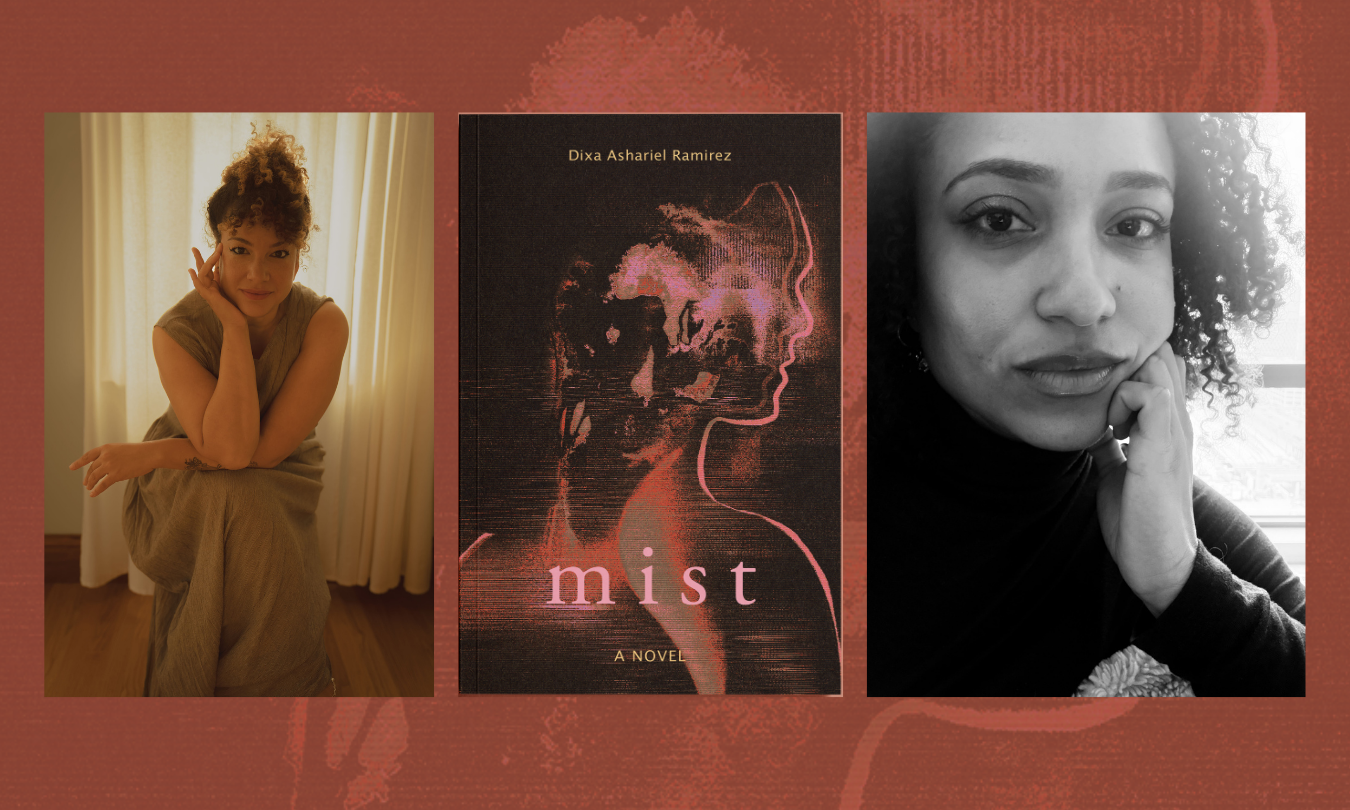
In Dixa Ashariel Ramirez’s Mist, Josefina Pujols, a beleaguered Professor in the Department of Inequality of the Races, Ethnicities, and Colonialities at Tanner University, the self-consciously forgotten ninth Ivy, just wants to find a project she loves, dodge her nosy graduate students, and get tenure. But first, Pujols must navigate fluid-spurting neo-performance artists, eternal bureaucracies, and cannibalizing (maybe literally?) race-fishing academics. All while trying to solve the mystery of the disappearance of Doralis Montero, a fellow Dominican academic, and answer the question of what exactly happened to Eula Johnston, a Josephine Baker-like superstar who keeps showing up in Josefina’s dreams. Is it any wonder that the final showdown in Mist is a cosmic battle for the future of our world?
Dixa Ashariel Ramirez’s Mist is a generic chimaera, blending satire, mystery, and the cult-novel, interwoven with humming, thrumming threads of ancient spirituality. In this interview, Dixa and I discuss the absurdities of academia, the dearth of the literary hottie, self-publishing, and ancient mysticism. Mist is currently available for order through Dixa’s website, Amazon, Barnes and Noble, Bookshop.org, and select independent bookstores. For more of her writings and to contact the author, please visit dixaramirez.com. She wants to hear from readers, those interested in reprinting or commissioning writings, and those who have had spiritual experiences. This summer, she is teaching a course on literature, film, and inner alignment that is open to the public through Morbid Anatomy.
Anya: Dixa, I’m so excited to talk to you about your recently published debut novel, Mist. I thought I'd start with what I found out was my own projection onto the book, which is this Tanner reference. Yeah, Tanner University, the 9th Ivy. Where did that name come from?
Dixa: First of all, I want to thank you for interviewing me for Apogee. I'm excited to talk to you about Mist.
I chose the name Tanner because it sounded like an old, established Anglo family name. Though fictional, I wanted it to retain the qualities of a prestigious university while also having an absurdist component being “The Ninth Ivy.” I made it an Ivy because I know that being tenured at a state university or community college has its own specific flavor.
Some people, like you mentioned earlier, have assumed that Tanner is a hilarious way of saying “Brown,” where I teach and where I was an undergrad. Because “tanner” is “more tan.” I wish I’d been that clever. But perhaps it’s even funnier to admit that it didn’t even cross my mind! Tanner is meant to be a composite of several Ivies and small Ivies situated away from the major cities. If people assume it’s a specific place, they would miss that it is meant to be a broad sketch. The book is meant to be archetypal.
Anya: The idea that prestigious colleges each have their own particular context is so important to the book. For example, Tanner's tenure review process differs from Yale’s and the way that they've chosen to approach diversity is a huge factor in what sets up the stakes of the novel. What did it kind of take to create that space? Was it research or lived experience?
Dixa: It relies on the textures of lived experience, but it is neither autofiction nor memoir.
So it includes the offhand comments related to the specific requirements, both written and unwritten, of what it is like to get tenure at a place like Tanner and why it is infuriating for Josefina and some of her friends that someone like Minerva, one of her colleagues, does no research but assumes promotion will come to her. It’s part of the conundrum that creates a space for Josefina to wonder: what is really happening here? Beneath the surface?
Anya: I’m thinking about some of the other references that a careful reader or a reader who's immersed in a Caribbean or Black American literary context might be familiar with. Some that came up were Kathleen Dunton who I read as Katherine Dunham, an American anthropologist who worked in Haiti. Dunham fully immerses herself within Haitian culture, particularly Vodoun, and Kathleen Dunton's character does something similar in Mist. How much research went into this book especially for that period? Am I making these connections erroneously or are they intentional?
Dixa: Yes, Dunton is loosely based on Katherine Dunham, but just at the level of her syntax as I discerned it in her writings and some recorded interviews, not strictly at the level of biography. Also, I didn't research anything once I started the novel. I had read Dunham with my dissertation advisor, Sara E. Johnson, who co-edited an anthology of Dunham's writings with her own dissertation advisor, Vèvè Clark. That’s prior research at the intellectual level.
There was another level of knowing in the novel, which is the level of embodied experience, as we’ve discussed. And that includes the mystical components that are not culturally Caribbean. Some of the visions Josefina has, and how they feel in her body, echo my own, but heavily fictionalized. For the many elements of Vodou in the novel, they are based on readings, including by anthropologist-practitioners like Mimerose Beaubrun and Rachel Beauvoir-Dominique. They’re not based on lived experience. But I had taken many Haitian dance classes, so I felt the importance of the pelvis in that movement tradition, as several characters discuss in the novel.
Anya: Let's talk about mysticism in this novel. I think there are two levels at which it's operating. The first level is at the level of plot. The narrator's dreams and visions connect her to the woman named Eula Johnston, who has mysteriously disappeared. The second level concerns the narrator's broader spiritual journey and thousand year history, moving away from the plot, and into what writers like Wilson Harris refer to as “cosmic love,” or the spiritual groundswell from which everything in our human realm activates. Do you read Harris at all? Does that play into it? And then if not, let's talk about mysticism more generally and how it's shown up in your life.
Dixa: When I had my divine visions of realms, sacred geometry, and being-architectures like seraphs, it fundamentally altered how I perceive reality. I also had repeated encounters in the luminous void, the being in non-duality, the nothingness before light and sound. It’s a state of pure I Am. This embodied knowing does not sit in the body and mind in the same way as something one reads and even conceptually understands. It imprints in one’s very cells. In fact, the experiences changed my body, healing physical damage I thought was permanent.
Some people have life-changing experiences like mine, but the realms and archetypes they encounter are deities from various pantheons. So, someone who encounters the ocean Orisha Yemayá, let’s say, may end up building their life in devotion to what she signifies to them. For me, and this was very surprising, the main archetype and architecture I encountered were seraphs (there are others, but it would take too long to elaborate here). I had not grown up with these figures. Seraphs are not angels as messengers, but architectures of precision and alignment.
These beings and realms are not above humanity, hierarchically. They are anterior or “before” because they are in the realms of light before refraction and densification into matter. This is how I perceive things phenomenologically. I do not have evidence. Every human has a translation of their original architecture in those realms. But only some end up “locking into” this architecture in a certain lifetime. Others choose to remain only in the world of matter. Neither is better than the other; they are simply different ways of experiencing the dream that is being alive in matter.
I’m writing a collection of essays elaborating on these experiences and about how they have influenced my readings of certain films and novels.
As for Mist, you said that these mystical visions kind of take us out of the plot. But to me the visions drive the largest shell of plot. The novel echoes mine and other people’s perception of multi-dimensional reality, meaning, that not everything exists only in the world we perceive with our five senses. There is a lot more. The novel opens with something terrible happening to a character named Eula. People are worried about her. Josefina's visions are not separate in that they become the portal through which Eula can be helped, because Eula is not in a place that one can get to by car.
Anya: Yeah, she's in space and time.
Dixa: She seems to be in a place that is beyond space and time. In a kind of suspension—I won’t say more because it reveals too much.
So, perhaps some readers would wonder, why include that at all in the novel when there is so much already going on in the “real” world of the characters? Why get into these strange realms? If I interpret my own novel after the fact, it was important for me to show that Josefina, and Doralis, another main character, went through very traumatic experiences and then healed from them through various forms of unexpected spiritual awakening. And so the traumas they endured did not come to define them, not in facile triumph or something. But because healing is actually possible and not always in the ways we might expect.
Anya: Right.
Dixa: Part of the comedy of the novel happens when Josefina and her friends laugh when they witness several of their colleagues capitalizing on identities that are fabricated or manipulated in strategic ways. One of the characters enjoys describing herself as a “Brown, first generation immigrant activist-scholar,” but Josefina and her best friend Leo laugh because this woman is a white Argentine from a wealthy background. But they also witness the benefits that her mantle of spoken identification, as it relates to potentially being a victim of systemic racist violence, offers her. And to be clear, it’s not like this character could never be a victim of anything. Of course she could be. But, in general, victimhood is not a permanent state of being; it is created by circumstance. This character could be a victim of something in one situation and not be a victim in relation to another situation. But for some of the characters, victimhood becomes congealed and strategic, rather than dynamic, relational, and something for which true resolution and healing should be sought.
Anya: One of the things that Mist does so well is it provides characters who are at different levels in their feeling victimized or not by the institution. One moment I'm thinking about is when Josefina finds out that she is among a list of “diversity” hires by the institution and her closest friend, Leo, essentially calls her naïve for expecting not to be part of a diversity push. Another example is in the ConKin performance, which is such a great send up of experimental performance art.
Dixa: Yes, Leo pushes back on Josefina. And Josefina has to think about why being a diversity hire bothers her at all. And ConKin stands for Contemporary Kinetics, the only humanities department receiving funding at Tanner.
Anya: Excuse me, Contemporary Kinetics. Contemporary Kinetics, perfectly emblazoned on my brain. It's ConKin now. But there's this, a scene of putting, and I don't want to spoil it, but putting the femme body on violent display. The performers are victimizing themselves, but also the audience. The performer is literally shooting bodily fluids onto the audience. And at the same time, there’s this trendy field that's getting all the funding and it's built on performers of color splattering out their juices onto other people.
Dixa: [laughs]
Anya: It’s a question that comes up in other forms throughout the book. But let’s come back to that idea of self-victimization and who benefits versus who pushes back against that identity, and what functions these various characters perform in the book. I leave this book and I wonder—is there any role for black and brown people in academia? I don't know. I'm so curious to hear your thoughts on that.
Dixa: I would ask, more broadly: does the person’s inner structure align with what the institution can provide? If not, how can the person make it work so that they are not in complete fragmentation when operating within it? I think different forms of compensatory fragmentation happen for everyone, no matter their background, in relation to institutions, even beyond academia. But the patterns of fragmentation are often influenced differently depending on someone’s background. For instance, how does an institution expect a Black woman to spend her time, energy, and how does the institution expect her to show “care”—care for others, care for her work and devotion, and so on, versus what the institution may expect from someone in another identity category. A lot of this often remains unconscious and tacit. I am always interested in what is beneath the surface operation, in literature, in history, in society, and in life. And when there’s a big mismatch between surface and actual action, I used to get frustrated, but now I register it as a kind of “systems error” and keep it moving. What I won’t do is fold myself into the logic of this “systems error.”
Anya: One thing that keeps seeming to come up is the valorization of the academic’s ability to convey pithy ideas to a broad audience who may or may not engage deeply or closely with their work. Performative activism, unserious criticism, social media engagement—all these seem to get in the way of doing research. Let’s talk about these two systems LumenPost and Click, Mist’s social media platforms.
Dixa: That’s a beautiful way of putting it. Yes, the novel takes place in 2019 in a world that is like our own but slightly parallel. So LumenPost is Instagram and Click is Twitter. The premise of the novel emerged from my observing how some posts, including those that I and others knew, included outright lies, getting a million likes. Social media became a place where watered down versions of ideas could be shared in a kind of righteous cadence, usually by people who did not originate the ideas and only cited the originator if it was one of the five fashionable scholars. It was interesting to witness over time, on social media and in my daily life as an academic, how ideas that I consider truly innovative—and here I don’t even mean my own, but my academic friends’ and graduate students’—not receive the same amount of funding, citationality, or public celebration as scholarship that I considered watered down or sanded down versions of truly innovative thought. This is a known phenomenon.
Anya: Watered down and trendy, I feel like are the two big things.
Dixa: I think institutions reward those who are good at replicability and echo—that includes academia but also the art world, the publishing industry, and so on. How can I replicate something that has been picked up by the right people at the right time, for whatever reason? This is one mode of doing scholarship. I think that people believe that academia rewards innovation, but I have observed that this is not always accurate, at least not in the various fields in the humanities that my work intersects. My own scholarship didn’t arise out of a vacuum, obviously. I have been immensely influenced by certain scholars and certain fields. But I always joked that I didn’t have a “theory daddy” or “theory mommy,” by which I meant that I wasn’t primarily driven in replicating a specific pre-existing model.
Anya: And I think that's part of the journey that Josefina goes through. She's on a pathway to tenure, which is very bureaucratic...
Dixa: And entirely based on external validation. By definition.
Anya: External validation. It's check marks that you tick off. And of course, if you're a scholar of color, a black scholar, a brown scholar, there are more items to check off. But Josefina finds a meaningful, even life-changing research project that can impact her life as well as the lives of others. Her research leads her to her own spiritual awakening. That's one of the really fascinating things that the novel is able to do. It's like, okay, we're setting it up as this frustrated academic who finds a real passion, a real, a real project that has the ability to mean something.
Dixa: And that taps into something I think a lot of us, who feel close to our creative impulse, feel in academia and beyond: where did the passion go? What am I willing to do to protect that passion? We are not in a world in which that passion is rewarded.
How do you protect it? You have to have your own internal reasoning. For Josefina, this gets into her alcohol problem. She likes the high. Other people have said this about alcohol abuse and other forms of substance abuse. To me, what's often happening is that somebody misses the high of their passion.
Anya: And they find a substitute.
Dixa: Exactly. That alcohol and other addictions may replicate. But really what you're missing is your soul. What you're missing is your fire. And it's like, you look around and maybe no one really gives a fuck about your fire except to maybe to pluck from it and then conveniently forget where it came from. And to water it down. The fire within each person is intense; it is raw. Many who meet this fire find it to be overwhelming and, therefore, many prefer the diluted versions.
Anya: Yeah. Plagiarism is a huge concern of the novel. But also this watering down for immediate success on social media.
Dixa: I call it idea laundering. I see it all the time.
One does feel a little bit like a detective trying to find the source. It becomes like a Nancy Drew mystery. My literary training—very rigorous, thank you Brown’s Comp Lit department and UCSD literature department—taught me that you follow the trail of the original quote.
Once, I was told to quote a certain person, a U.S.-based scholar in an interdisciplinary field, by a peer reviewer. And I did not blindly quote that person. Instead, I searched who that person was quoting in the relevant section. Oh, how interesting, this person is quoting this person. Let me go to that person and see who they're quoting. At the end of the trail of breadcrumbs, I found that the original innovator all along was the person I was originally quoting. And they happened to be a Caribbean scholar. Anya, I am not lying or exaggerating. I’m telling you exactly as it happened. The scholar I was told to cite was not doing anything wrong. He had properly cited his source. Same with the next one. I’m talking about a culture of trendy, circular, insular citationality.
And so I'm sitting there with that internal laugh of being someone who notices pattern. I think: here’s the pattern again.
Anya: And it's going to keep coming up.
Dixa: I no longer feel frustrated. I now simply observe. Some academics may read my novel and “feel a type of way” about some of the critiques I make, but, if you read closely, you will note that one of the poignant things Josefina says is: “I got a PhD and dreamed of this job because I love literature. What happened to that love?” I think many academics can relate to that feeling. The novel is a paean to that feeling. Where did it go? What forces are trying to destroy it?
Anya: By the end of the novel, Josefina is approaching a similar revelation. Without spoiling, I’ll just say that there is a spiritual, maybe psychological showdown between two elements that have been at war in the novel. That's where it gets mythical. But I still find that we end on a choice that we don't necessarily see the outcome of. [Dixa: it's a classic threshold novel]. What comes after the novel for Josefina or for the novel's broader ideas?
Dixa: I will let the reader imagine. And who knows what route Josefina will take?
Anya: Great question. We don't know.
Dixa: I left it purposefully vague because Josefina's not a perfect character. She's our heroine, sure. I hope people actually cheer for her, though I expect some people will be frustrated by her. But she has her foils. Even her best friend, Leo, often disagrees with her.
Anya: And I think that's the right choice. But, you know, I'm hoping for a sequel. I'm sure many readers will be.
Dixa: I’m writing a prequel that takes place a thousand years earlier.
Anya: Yes, yes. If it's written by you, I'm sure I'll love it. What were some of your literary inspirations for you in writing Mist? Some novels that Mist called to mind for me were René Depestre's Hadriana in All My Dreams, Marie Vieux-Chauvet's Dance on the Volcano and Paule Marshall’s Praisesong for the Widow. But there's also this humor, satirical element, that reminds me of Danzy Senna's Colored Television.
Dixa: I love this question. I wasn’t thinking about different texts as I wrote, but, now that I’m finished, I fantasize about its potential bookshelf mates. For instance, I just taught Nella Larsen's Quicksand, and I realized that my novel is one potential answer to the question of: what if the society around Helga Crane had not completely destroyed her inner fire? What if she had chosen differently?
A childhood influence that could also be an ideal bookshelf mate—though perhaps not in terms of age category—is the Nancy Drew stories. I love Nancy Drew.
Anya: Yeah, me too. I was a Nancy Drew girl. Hardy Boys? Never heard of them.
Dixa: Love a Nancy Drew situation. And, more broadly, I just love an irreverent heroine. You do too, hello, considering the classes we’re teaching right now. I’m teaching “Literatures of Misbehaving Femmes” and you’re teaching “Weird Women’s Writing, Writing Weird Women.”
Anya: Yes!
Dixa: Frankly, there are not that many irreverent heroines of color. I yearn for more tales in which the imperfect heroine observes something astute about the world around her and is always wearing cute shoes. And she happens to not be white. Josefina at one point is wondering if she's depressed because she's re-watching her two favorite depressive movies. And she's like, “oh look, just me and two sad white girls.”
Anya: Do we get the names of those films?
Dixa: Yeah, we do. Melancholia and Le rayon vert. I wanted to create that heroine who is frustrating at times, interested in fashion, has “issues,” but also directly faces deeply existential crises and does not suppress them. That's why I love Helga Crane. But it's rare. Beyond that, I love literary horror.
Oh, I cannot forget three authors of irreverent, haughty Caribbean femmes: Jamaica Kincaid, Maryse Condé, and, as you mentioned earlier, Marie Vieux-Chauvet. They have all deeply inspired me.
Anya: Hotties. The literary hotties.
Dixa: Haughty hotties.
Anya: Yeah, we love them. We love them. [Maryse Condé’s] I, Tituba—
Dixa: And [Condé’s] Hérémakhonon. And they're not necessarily likable.
Anya: And it does seem like likability, the ability to get by, not ruffle any feathers, follow the rules, is rewarded by the power system at the center of Mist. And it's only the characters who can push back, reject the system that have the ability to break that shit down eventually. Maybe.
Dixa: Or be victims to it.
Anya: Yeah. I think Doralis' character is such an interesting one because she's really forced out. She's forced out of academia. She's forced out of the country.
Dixa: She's forced out of the dimension!
Anya: She’s forced out of the dimension exactly. [Dixa: She remained tethered slightly]. Slightly, yes she was able to make an outreach, but it's a challenge. There are characters who are pushing along and, you know, things may work out for them or they may not. This brings us back to the question: what happens next? We don't have all the answers.
Dixa: I think of Leo, the best friend character. It’s not that he's a “sellout”, but he is making do, and making do requires that he not touch deeper currents. When Josefina, without revealing too much, is going down her rabbit hole of, “there's more, there's more to this.” Leo’s like, “no.” He's trying to remain on solid ground, whereas Josefina and Doralis are both willing to see things differently, but there are enormous risks to doing so.
Anya: Again, not to spoil too much but there are also some characters who benefit from the system and prop it up who are willing to betray it, and that's an important moment for the novel as well to show that even when you're born into a system, there's this possibility to push back.
Dixa: Everyone has potential in the novel, but it does satirize various archetypes. But everyone has the potential to shift what matters to them. And I think you’re referring to the characters who are like cogs in the machine, doing work that they perceive to be helping certain groups but are, in fact, extracting from them. Those characters expect the ones they’re supposedly helping to act a certain way, and so either one is naturally like this idealized helpful person from a certain group, or one is performing as if one is that, or one refuses and gets seen as a problem. It’s like one does not only get the job one trained for—for Josefina it was literature professor—she also has to wear a personality that is not her own to showcase proper amounts of gratitude that you even have the job. She tells Leo at one point, “I got the degree, I wrote the book, I got the awards, I get the excellent teaching evaluations, and somehow I still have to show an extra layer of something?” Leo doesn’t really let it get to him. It was important for me to show that what Josefina cares about is not what everyone, even those who share her “identity,” cares about. But she’s just always wondering why there’s always an ineffable “more” than what she had already done. A “more” that is not demanded from everyone. And that “more,” or “certain way” as the novel repeats, that helps her in her investigation.
Anya: Right, right. One of the things that Mist is really about is taking away people's masks and stripping down to their essential selves. Academia is a mask, but also there’s the essentializing of culture happens for many of the characters in this novel. Did you see that stripping back as a key theme of the novel?
Dixa: Yes, it’s a foundational element of the novel and it echoes a key part of how I am in the world as I mentioned above. What might sit beneath the scripts, beneath the performance? But discerning a gap between word and deed does not mean that person needs to be judged negatively. Sometimes people wear masks because they have to. Sometimes people wear masks because it's strategic. Sometimes people wear masks because that's all they've ever known. Growing up I had to wear many masks, because whenever I revealed anything real, it was neither encouraged nor supported, to put it mildly.
It makes me really happy that you detected that foundational element of the novel.
Anya: Let's move to a question about process. You said that writing Mist just felt like the words were pouring out of you. Does that come from having done so much research? Does it come from the story feeling close to you, personal? Does it come from feeling like fiction writing is like a freer, medium than scholarly writing? I often feel so frustrated as a writer and I love to hear when people can talk about writing as like a fountain.
Dixa: When you write from passion and inner flame, there is no writer’s block. Because writer’s block then becomes something else: a need for rest or metabolization. It is the pause before the next breath. Divine inspiration doesn't give a crap about market desires or “productivity.” But, of course, discipline is still required. Some may apply that discipline to writing for a certain amount of time per day or producing a certain number of pages—something I have done and which helped me finish my other books. But, now, the discipline I apply is devotional to my inner flame. Because of that, I don’t force myself to write if my body is telling me not to. The body has various intelligence centers besides the brain, and they give you important information about when and how to move in the world. People have to entrain themselves to discern the signals from each intelligence center. If I need to rest, to read, to do other kinds of tasks, then that is what I will do. Creation and generation are not one endless exhale; they require pause and inhale.
To be clear, one approach is not “better” than another. They are different paths serving different goals. The writer who is diligent about productivity may be rewarded with market success; the one who is diligent about her inner flame is guaranteed only the reward of creating itself.
Anya: I'm wondering if self-publishing also has to do with that. I’d love to talk about how you've felt about that journey so far.
Dixa: There is freedom, but it comes at a cost. Over a year ago, I sent an earlier version of the novel to a few agents, who declined to represent me. This was difficult for me, but, after that, coincidentally, I had my most intense lifechanging mystical transformations and realized that devotion to my inner flame required prioritizing my voice, my time, my aesthetics. Without negotiation. Even if it cost me a larger audience and that external proof of acceptance that many bookstores require. Even if I knew some would find it cringe as I myself once did. I pulled my novel from being considered by the remaining agencies and publishers and committed to releasing it myself. What was fascinating was that I did so with immense joy and creative excitement, not in resignation. It felt like a creative challenge. I was also thrilled to have more control over timing. The delays attendant to traditional publishing can truly curtail the momentum intrinsic to how inner flame moves. By the time my other works have been published, they end up feeling somewhat inert to me. Especially when they’ve gone through a lot of external editing I didn’t truly agree with. Self-publishing has allowed me to feel that my work is coming out into the world at its most pulsating and alive.
Coincidentally, I’ve gotten the most compliments on my writing on the works that were least “smoothed out” by aggressive editing. And so it’s also not about foregoing quality. I am a perfectionist when it comes to the quality of my work. But it is one thing for an editor to look at a roaring fire and throw water on it to make it smaller and more palatable, and another for an editor to look at this roaring fire and say: “Let me clear out the smoke so that people can really experience this fire without obstruction.” I hired an editor for Mist and instructed him to help me with the latter.
When self-publishing came up years ago, before I even began writing the novel, I thought, or even said out loud, “Self-publishing? Over my dead body.” Why would I say that? Is it because there's something inherently wrong? There isn’t. But it is wrong for a woman who grew up with the conditioning that every action taken, every desire, needs to first be approved externally. In that sense, having that reaction makes perfect sense. Indeed, that woman did have to die. And she did. She died.
Anya: I completely agree. And, not to draw too many comparisons, but the checkbox of the tenure file to me does mimic in many ways the academic or the traditional publishing route. It seems like there are many gatekeepers, as well as this large market validation that supposedly doesn't exist in the university context. Well, it’s a neoliberal institution, of course it does. And I just really want to emphasize that Mist is an incredible book, well researched, well thought out, well written. And it is a beautiful object.
Dixa: Thank you.
Anya: Wonderful. Are there any final takeaways? Or ways that you want your ideal reader to approach the book?
Dixa: Yeah. I hope several things. I hope that people read the characters archetypally: the real activist, the performative activist. The scholar who's passionate about their work and the one who doesn't have any scholarship, but tweets dozens of times a day. Or Clicks, rather. These are archetypes. And they don't have to be mythical. They are run-of-the-mill people. I hope people find my novel entertaining. [Anya: totally, I think you achieved that]. Thank you. A fun little whodunit that does get dark, but is still a hopeful, mythical and mystical whodunit. Some people might find the novel confronting at times, if they have themselves participated in systems in ways they didn't realize they were participating in. And that’s not a bad thing.
Anya Lewis-Meeks is a writer from Kingston, Jamaica, nonfiction editor at Apogee Journal, and current Presidential Postdoctoral Fellow in Literary Arts at Brown University. A recent Duke PhD in English, she holds an MFA in Fiction Writing from Columbia University, and a BA from Princeton. She has benefited from the Callaloo Writer's Workshop and the Kimbilio Fiction Writer's Retreat. Her writing has been published in LitHub, Triangle House, Nausikae and elsewhere. She is currently at work on two novels, The Program, about a woman investigating the disappearance of a woman she knew from graduate school while anxiously awaiting her marriage-based green card and Bloodseed, about a Kingston-based eco-activist group battling a climate-imperiled future.
Dixa Ashariel Ramirez teaches literature at Brown University and has published extensively in the world of scholarship. Now, she also weaves fiction and non-fiction writings from divine flame. Her debut novel, Mist, is one such weaving. She is currently writing a second novel, a prequel to Mist set in 1000 CE, and a collection of essays about spiritual awakening and the nature of reality in literature, film, and her personal life. Find her at dixaramirez.com and @dixaasharielramirez on Instagram.